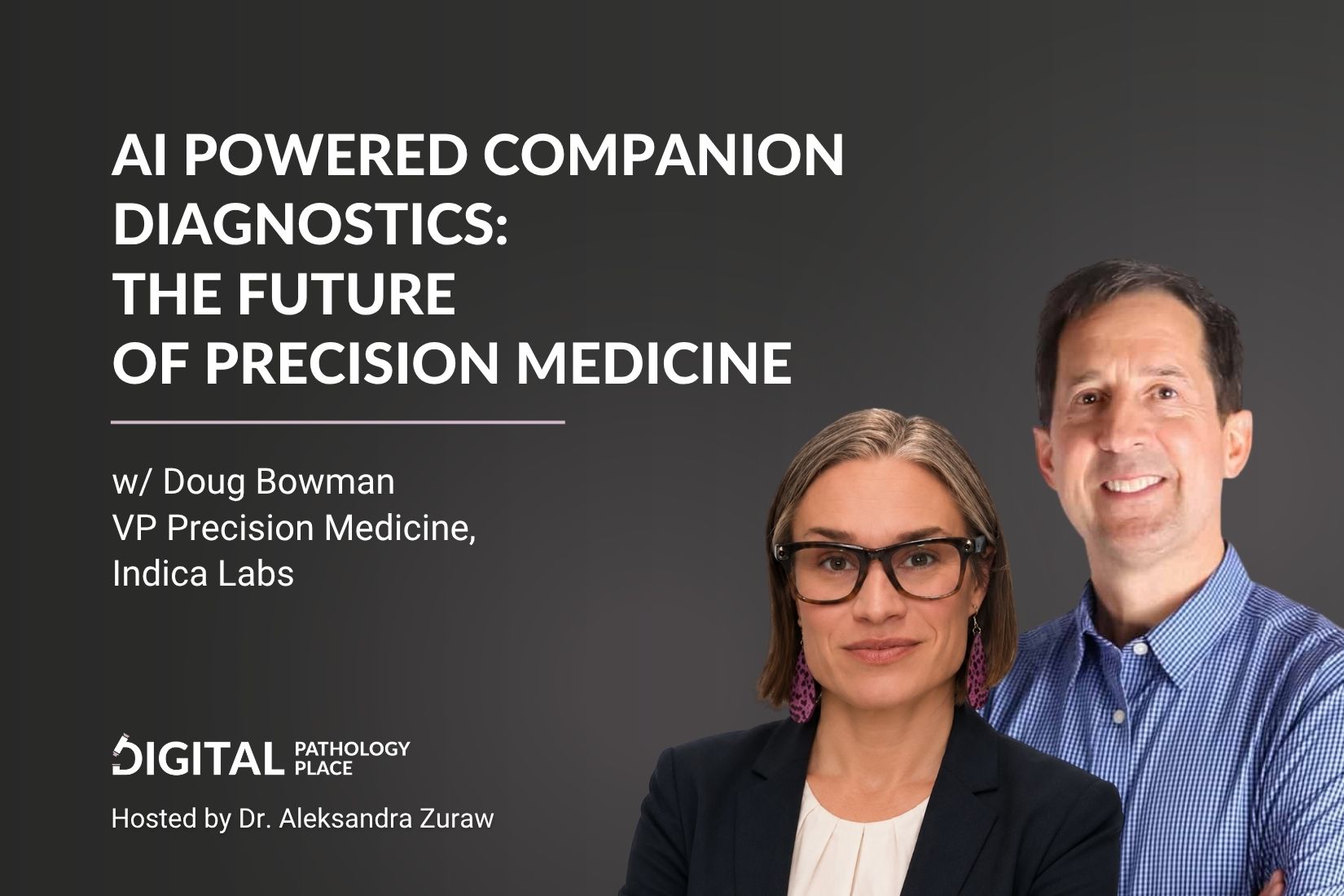
Doug comes from a biomedical and electrical engineering background, with experience in microscopy, digital image analysis, pharma workflows, and now precision medicine at Indica Labs. That combination makes him a great person to talk to about how image analysis actually fits into real companion diagnostic development.
We start with a very practical question: what is a companion diagnostic, and why is it becoming so important in precision medicine? Doug explains that companion diagnostics are developed alongside therapeutics to help identify which patients are most likely to benefit from a specific treatment, especially in more complex therapies like antibody-drug conjugates (ADCs). We use HER2 as an example, and from there we get into the real challenge: once a biomarker cutoff matters clinically, visual estimation around that cutoff becomes much harder than many people want to admit.
That is where this conversation gets especially useful for pathologists and digital pathology trailblazers. We talk about the limits of human vision, why low or ultra-low biomarker expression is difficult to score consistently, and how AI helps at multiple levels of the workflow: slide QC, tissue classification, cell segmentation, membrane and cytoplasmic measurement, and spatial analysis. Doug makes the case that AI is not only a convenience here. In some cases, it is the only realistic way to capture the kind of quantitative information modern therapies need.
We also get into one of the more interesting examples from the episode: the Trop2 story, where a ratio of cytoplasmic to membrane expression appears to predict therapeutic efficacy better than looking at one compartment alone. That kind of compartment-level quantitation is exactly where computational pathology becomes more than a digital version of what the eye already does. It starts uncovering measurements and signatures the eye cannot reliably extract on its own.
Another important part of the discussion is workflow and regulation. Doug walks through how AI-powered companion diagnostics are developed from preclinical work, to human feasibility studies, to RUO or clinical trial assays, and eventually toward analytical and clinical validation with regulatory engagement happening early. We also talk about the Indica Labs and Leica Biosystems partnership, and why end-to-end capability matters when you are trying to build something clinically deployable rather than just analytically interesting.
What I liked about this conversation is that it stayed grounded. We did not talk about AI as magic. We talked about image analysis as a method, companion diagnostics as a workflow, and precision medicine as something that only works when the measurement is good enough to support real decisions.