Foundation models may improve the robustness and generalizability of digital pathology AI. But a large model alone isn’t a clinical solution.
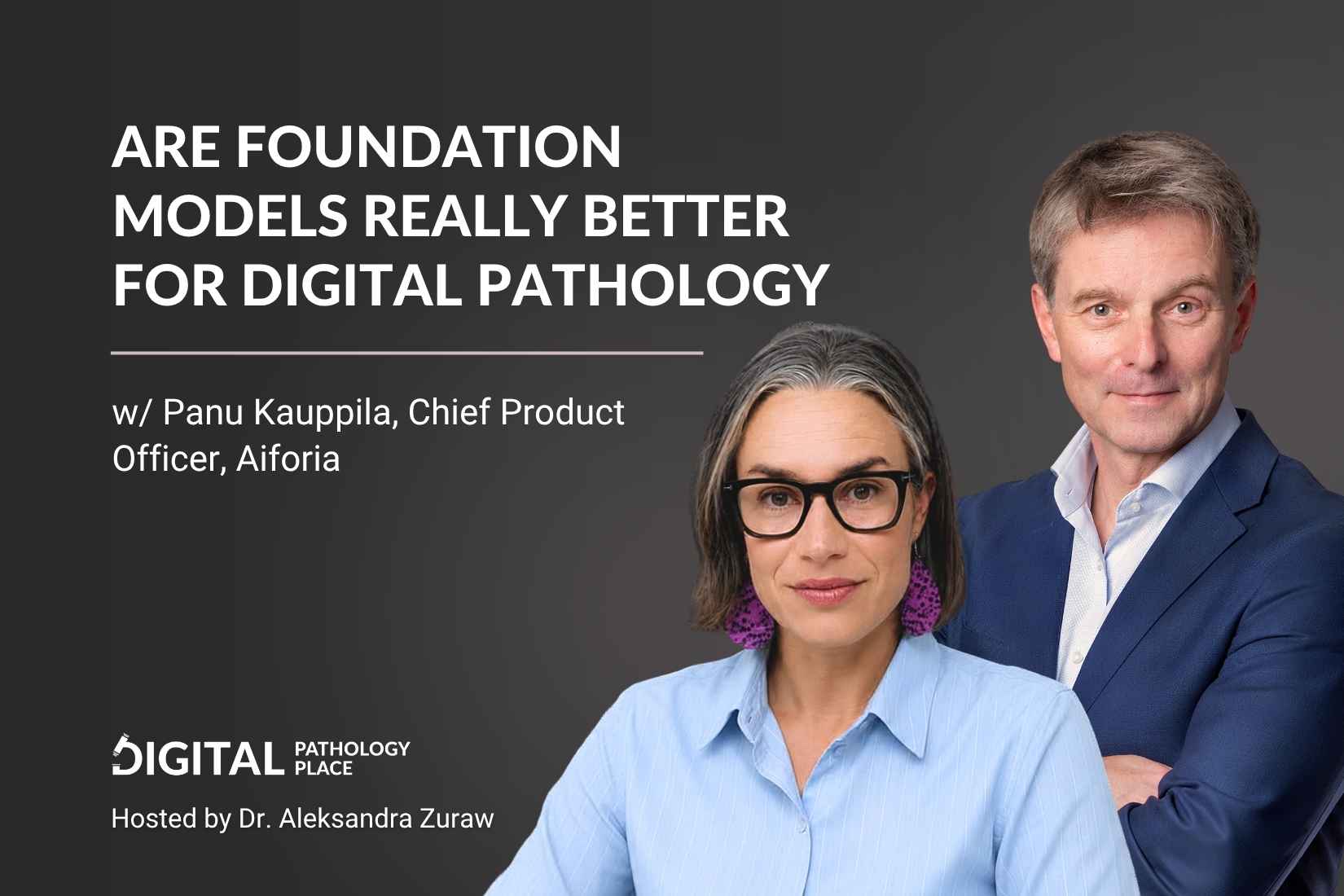
In this Digital Pathology Podcast episode, Dr. Aleks Zuraw speaks with Panu Kauppila, Chief Product Officer at Aiforia, about how foundation models move from research environments into practical pathology workflows.
Panu explains how foundation models differ from traditional convolutional neural networks. Instead of focusing mainly on localized image features, foundation models provide broader contextual image understanding. They can then be combined with adapters, task-specific heads, and curated annotated data to perform defined pathology tasks.
The discussion examines the practical tradeoffs. Larger models require more computational resources and can slow down analysis. Clinical AI must therefore balance model performance with speed, cost, usability, and integration.
Panu also explains how Aiforia Create allows researchers to compare supported foundation models with existing CNN-based models in a no-code environment.
The episode concludes with a discussion of bias, explainability, multimodal AI, data governance, regulatory oversight, and the future of predictive and prognostic pathology models.