Can visual IHC scoring keep up with the increasing precision of targeted oncology therapies?
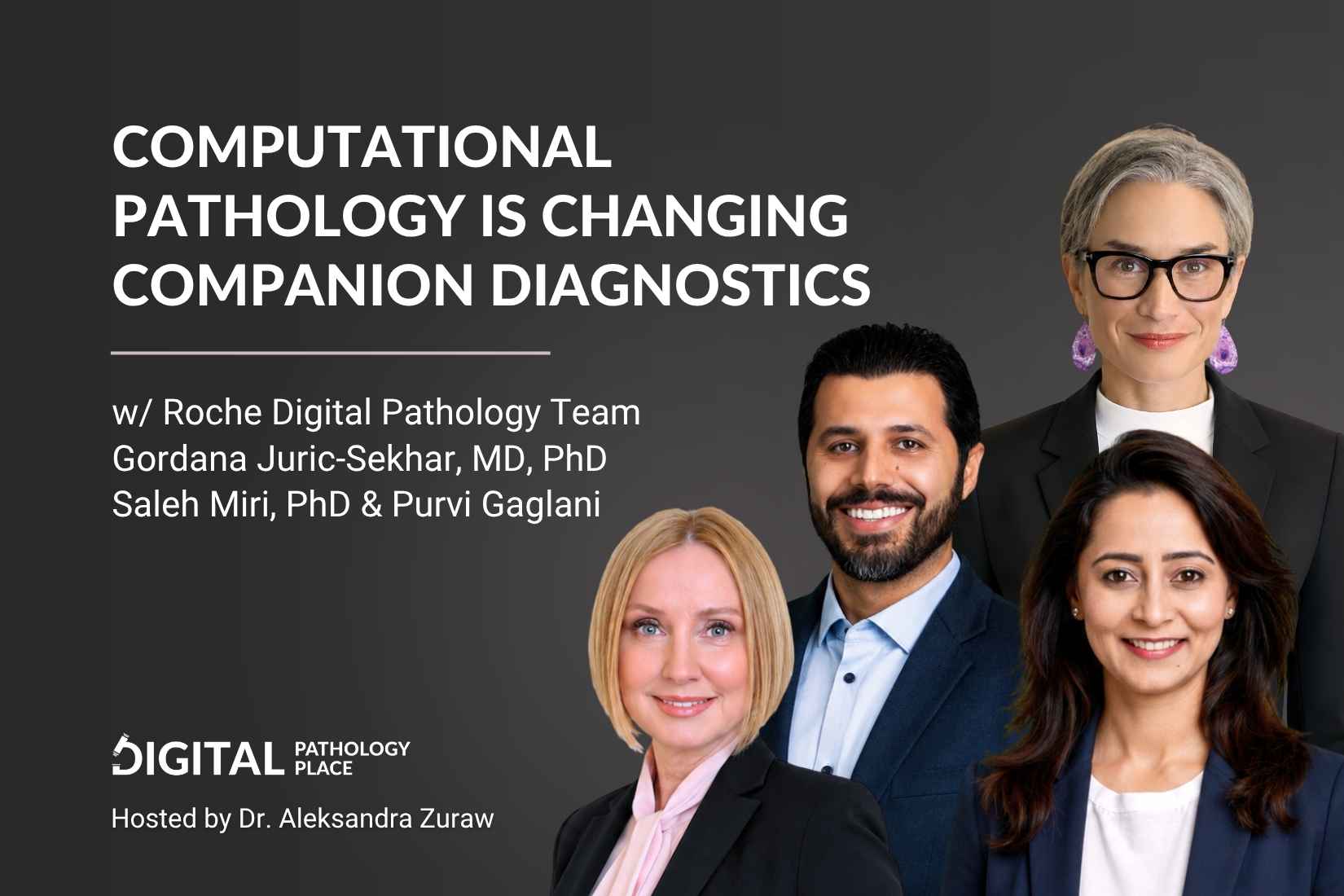
In this Digital Pathology Podcast episode, Dr. Aleks Zuraw speaks with Roche experts Dr. Gordana Juric-Sekhar, Saleh Miri, PhD, and Purvi Gaglani about the evolution of companion diagnostics.
Traditional companion diagnostics rely heavily on pathologists visually estimating biomarker expression. This approach helped establish precision oncology, but it also introduces variability and reduces continuous biological information to broad categories.
Computational pathology offers a different approach. Algorithms can assess biomarker expression at the individual-cell level, quantify tumor heterogeneity, evaluate spatial relationships, and produce continuous measurements that are difficult or impossible to reproduce visually.
Using TROP2 in advanced non-small cell lung cancer as an example, the guests explain the normalized membrane ratio and why this computational measurement differs from conventional computer-assisted scoring.
The discussion also examines the pathologist’s evolving role. Pathologists remain responsible for tissue quality, staining, scanning, tumor selection, quality control, interpretation, and clinical oversight.
Finally, the guests outline the regulatory and laboratory requirements for computational companion diagnostics, including end-to-end validation, validated digital infrastructure, cybersecurity, preanalytical process control, and new forms of digital pathology literacy.